THE WORKSHOP
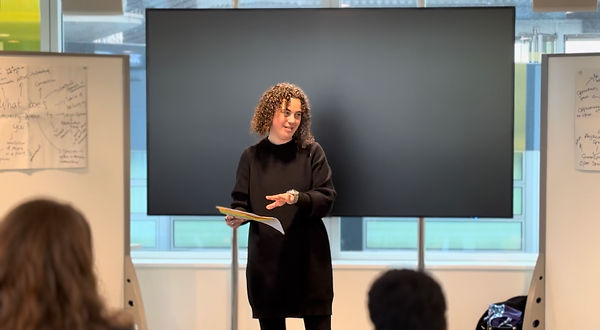
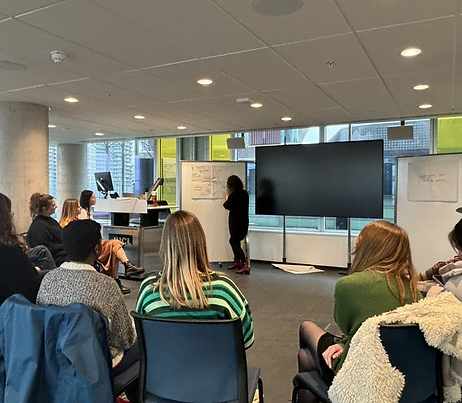
The idea of community at UCL East was explored at a workshop held on campus on 21st February 2024. Open to all UCL East students it was advertised through social media, campus email newsletters and by the project team directly inviting students by approaching them out and about on campus. Twelve students attended on the day.
The workshop was student led with the project team facilitating discussions to create an informal atmosphere and safe space for sharing. Content for the time capsule was collected in multiple ways during the workshop from online surveys, to whole group and small group discussions and written responses with the aim of giving everyone who attended the chance to contribute as much or as little as they wanted.
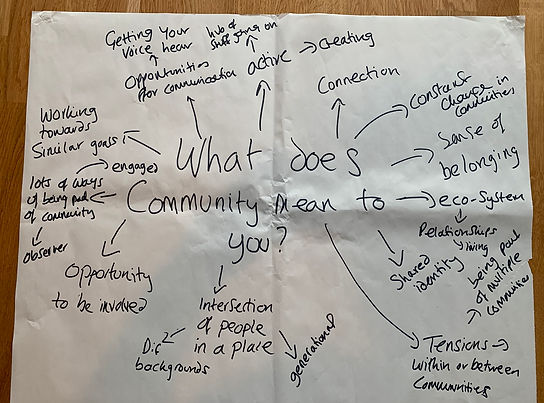
The participants began by thinking about the best things and the biggest challenges they had found studying at the new campus. Working in small groups with a member of the project team they shared their thoughts on flipchart sheets revealing lots of common threads.
After a whole group discussion reflecting on what community meant to the participants and what provides a sense of community each participant was asked to write a short reflection on whether they felt part of a community at UCL East and if they didn’t what would help them to feel part of a community.
Several reflections showed a strong sense of community was provided by classmates but there was little in the reflections suggesting that a wider sense of community was emerging at UCL East. As one participant wrote: “I wish there was more community outside of class. The campus doesn’t feel conductive to deeper community than studies”
However, participants were clear what would help them to feel part of a community highlighting a desire for more informal spaces like a pub or bar rather than just study spaces to meet other students, more events or making it easier to find out about events that were happening and events taking place outside of working hours. All of these are provided at the Bloomsbury Main Campus and experiences there may have shaped participants views of how student communities develop and what they feel like.
Clearly communities need to be built over time and the reflections from the workshop participants suggest that in the first full year of UCL East a sense of community beyond classmates has not yet emerged – it will be interesting to see how this changes in the future.
The reflections provide a snapshot of this moment in time and by placing them in UCL’s archive it is hoped they will be a valuable resource to future researchers writing about the development of the new campus. Not just the decision-making, buildings and leadership but how the first cohort of students experienced the new campus ensuing the student voices are included in the story of UCL.